OU blog
Versions
Current version
4.4 r1 (2024020100)
4.4 r1
Plugin type: Activities
Frankenstyle component name: mod_oublog
Version build number: 2024020100
Version release name: 4.4 r1
Maturity: Stable
Supported Moodle versions: 4.4
Repository URL (Git): https://github.com/moodleou/moodle-mod_oublog
Repository branch: MOODLE_404_STABLE
Repository tag:
Issue/bug tracker URL: https://github.com/moodleou/moodle-mod_oublog/issues
OU blog
Copyright 2024 The Open University
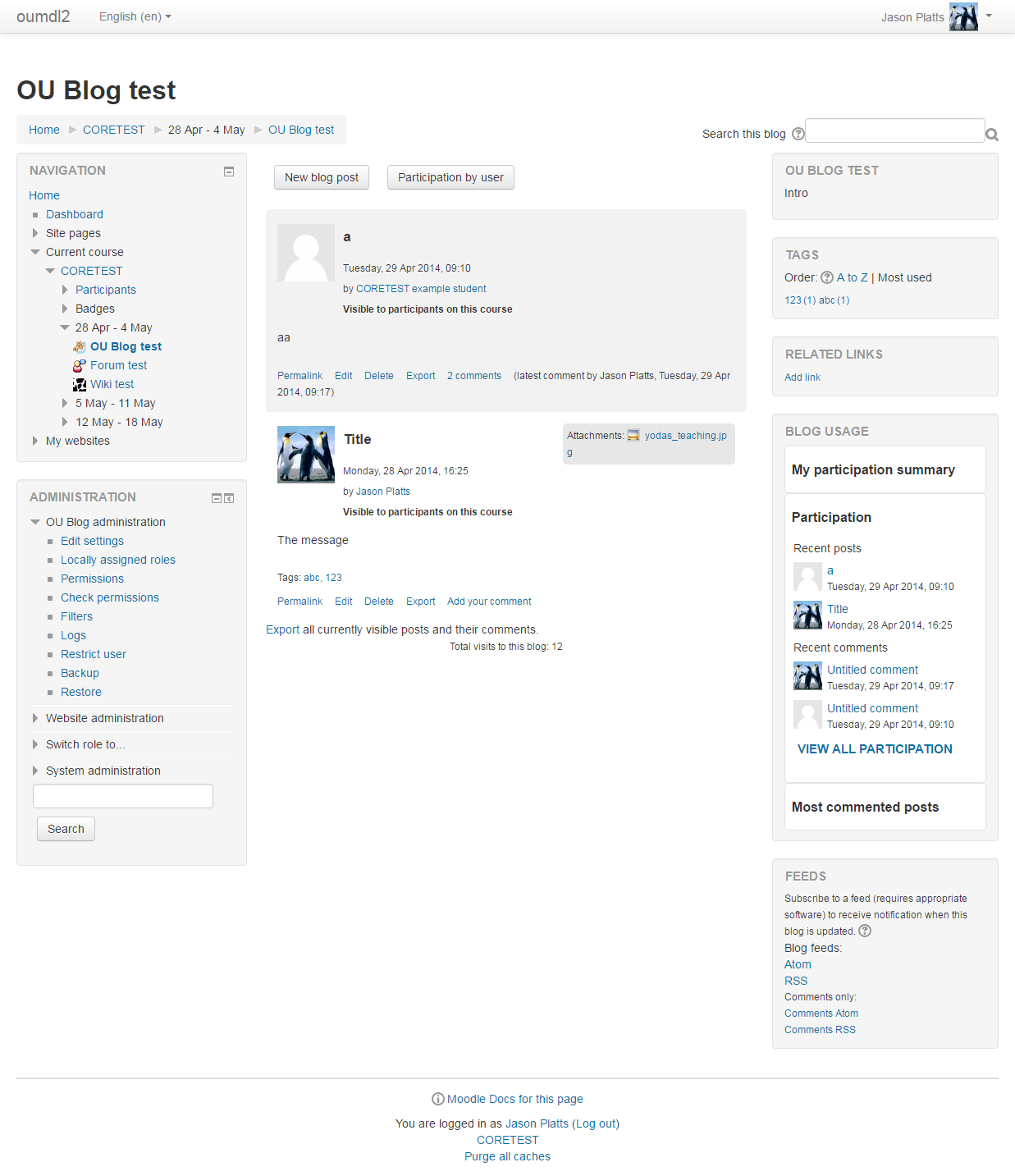
This is an alternative blog that you can install into standard Moodle.
It does not replace the standard blog, and operates alongside it. There
are two modes of use:
As a course activity. In this case you can use it the same way as any
other module. You can have course-wide blogs (everyone in the course posts
to the same blog), group blogs, or individual blogs; the latter are
useful for assessed activities (where the student is supposed to keep
a journal which only they and their tutor can read).
As a replacement for standard Moodle personal blogs. In this case it would
be a good idea to turn off the standard Moodle blog system, or it'll be
very confusing. You then need to MANUALLY provide students with a link
to mod/oublog/view.php which will automatically take them to their
personal blog.
When using for personal blogs, one feature of interest may be moderated public
comments; when you allow comments from people who are not logged in, all such
comments are moderated.
Branch:
This is the development branch including latest, untested code. If you would
like a tested version equivalent to an OU live release, please switch to a
branch that matches your Moodle version (e.g. MOODLE_22_STABLE) using the
above dropdown.
Support:
We cannot offer direct support. Please do not contact me directly. If you
need assistance, try the blog forum on moodle.org. (Remember to make clear
that you are using OU blog and not the standard blog.)
Documentation:
None. Please feel free to contribute documentation in the relevant area of
the MoodleDocs wiki.
Bug reports:
Please report bugs using the GitHub 'Issues' tab (experimental). Before
reporting a bug, please try the latest version to verify that the problem
hasn't already been fixed. In each bug, please remember to give:
- Exact steps to reproduce your problem, starting from creating a new wiki
with default or specified settings. - The ouwiki version you are using (from version.php or Modules admin screen).
Reliability:
Please note that this code is tested on OU systems but we rely on the
community for testing on other systems.
Requires:
Moodle 4.4.+
Postgres / MySQL
Install:
Place the contents of this source tree into your Moodle installation so that
within your Moodle root, this file is mod/oublog/README. Then visit the
Moodle notifications page to install.
If you want the blogs to be searchable, you also need to install the
local_ousearch plugin. (It is best to do this before using OU blog much,
otherwise it takes ages to install as it builds indexes for everything.)
When you install the ousearch plugin, a search box will automatically appear.
3.11 r1 (2020091403)
3.11 r1
Plugin type: Activities
Frankenstyle component name: mod_oublog
Version build number: 2020091403
Version release name: 3.11 r1
Maturity: Stable
Supported Moodle versions: 3.11
Repository URL (Git): https://github.com/moodleou/moodle-mod_oublog
Repository branch:
Repository tag:
Issue/bug tracker URL: https://github.com/moodleou/moodle-mod_oublog/issues
OU blog
Copyright 2012 The Open University
This is an alternative blog that you can install into standard Moodle.
It does not replace the standard blog, and operates alongside it. There
are two modes of use:
As a course activity. In this case you can use it the same way as any
other module. You can have course-wide blogs (everyone in the course posts
to the same blog), group blogs, or individual blogs; the latter are
useful for assessed activities (where the student is supposed to keep
a journal which only they and their tutor can read).
As a replacement for standard Moodle personal blogs. In this case it would
be a good idea to turn off the standard Moodle blog system, or it'll be
very confusing. You then need to MANUALLY provide students with a link
to mod/oublog/view.php which will automatically take them to their
personal blog.
When using for personal blogs, one feature of interest may be moderated public
comments; when you allow comments from people who are not logged in, all such
comments are moderated.
Branch:
This is the development branch including latest, untested code. If you would
like a tested version equivalent to an OU live release, please switch to a
branch that matches your Moodle version (e.g. MOODLE_22_STABLE) using the
above dropdown.
Support:
We cannot offer direct support. Please do not contact me directly. If you
need assistance, try the blog forum on moodle.org. (Remember to make clear
that you are using OU blog and not the standard blog.)
Documentation:
None. Please feel free to contribute documentation in the relevant area of
the MoodleDocs wiki.
Bug reports:
Please report bugs using the GitHub 'Issues' tab (experimental). Before
reporting a bug, please try the latest version to verify that the problem
hasn't already been fixed. In each bug, please remember to give:
- Exact steps to reproduce your problem, starting from creating a new wiki
with default or specified settings. - The ouwiki version you are using (from version.php or Modules admin screen).
Reliability:
Please note that this code is tested on OU systems but we rely on the
community for testing on other systems.
Requires:
Moodle 2.2+
Postgres / MySQL
Install:
Place the contents of this source tree into your Moodle installation so that
within your Moodle root, this file is mod/oublog/README. Then visit the
Moodle notifications page to install.
If you want the blogs to be searchable, you also need to install the
local_ousearch plugin. (It is best to do this before using OU blog much,
otherwise it takes ages to install as it builds indexes for everything.)
When you install the ousearch plugin, a search box will automatically appear.
3.11 r1 (2020091402)
3.11 r1
Plugin type: Activities
Frankenstyle component name: mod_oublog
Version build number: 2020091402
Version release name: 3.11 r1
Maturity: Stable
Supported Moodle versions: 3.11
Repository URL (Git): https://github.com/moodleou/moodle-mod_oublog
Repository branch: MOODLE_311_STABLE
Repository tag:
Issue/bug tracker URL: https://github.com/moodleou/moodle-mod_oublog/issues
OU blog
Copyright 2012 The Open University
This is an alternative blog that you can install into standard Moodle.
It does not replace the standard blog, and operates alongside it. There
are two modes of use:
As a course activity. In this case you can use it the same way as any
other module. You can have course-wide blogs (everyone in the course posts
to the same blog), group blogs, or individual blogs; the latter are
useful for assessed activities (where the student is supposed to keep
a journal which only they and their tutor can read).
As a replacement for standard Moodle personal blogs. In this case it would
be a good idea to turn off the standard Moodle blog system, or it'll be
very confusing. You then need to MANUALLY provide students with a link
to mod/oublog/view.php which will automatically take them to their
personal blog.
When using for personal blogs, one feature of interest may be moderated public
comments; when you allow comments from people who are not logged in, all such
comments are moderated.
Branch:
This is the development branch including latest, untested code. If you would
like a tested version equivalent to an OU live release, please switch to a
branch that matches your Moodle version (e.g. MOODLE_22_STABLE) using the
above dropdown.
Support:
We cannot offer direct support. Please do not contact me directly. If you
need assistance, try the blog forum on moodle.org. (Remember to make clear
that you are using OU blog and not the standard blog.)
Documentation:
None. Please feel free to contribute documentation in the relevant area of
the MoodleDocs wiki.
Bug reports:
Please report bugs using the GitHub 'Issues' tab (experimental). Before
reporting a bug, please try the latest version to verify that the problem
hasn't already been fixed. In each bug, please remember to give:
- Exact steps to reproduce your problem, starting from creating a new wiki
with default or specified settings. - The ouwiki version you are using (from version.php or Modules admin screen).
Reliability:
Please note that this code is tested on OU systems but we rely on the
community for testing on other systems.
Requires:
Moodle 2.2+
Postgres / MySQL
Install:
Place the contents of this source tree into your Moodle installation so that
within your Moodle root, this file is mod/oublog/README. Then visit the
Moodle notifications page to install.
If you want the blogs to be searchable, you also need to install the
local_ousearch plugin. (It is best to do this before using OU blog much,
otherwise it takes ages to install as it builds indexes for everything.)
When you install the ousearch plugin, a search box will automatically appear.
3.9 r2 (2020091401)
3.9 r2
Plugin type: Activities
Frankenstyle component name: mod_oublog
Version build number: 2020091401
Version release name: 3.9 r2
Maturity: Stable
Supported Moodle versions: 3.9
Repository URL (Git): https://github.com/moodleou/moodle-mod_oublog
Repository branch: MOODLE_39_STABLE
Repository tag:
Issue/bug tracker URL: https://github.com/moodleou/moodle-mod_oublog/issues
OU blog
Copyright 2012 The Open University
This is an alternative blog that you can install into standard Moodle.
It does not replace the standard blog, and operates alongside it. There
are two modes of use:
As a course activity. In this case you can use it the same way as any
other module. You can have course-wide blogs (everyone in the course posts
to the same blog), group blogs, or individual blogs; the latter are
useful for assessed activities (where the student is supposed to keep
a journal which only they and their tutor can read).
As a replacement for standard Moodle personal blogs. In this case it would
be a good idea to turn off the standard Moodle blog system, or it'll be
very confusing. You then need to MANUALLY provide students with a link
to mod/oublog/view.php which will automatically take them to their
personal blog.
When using for personal blogs, one feature of interest may be moderated public
comments; when you allow comments from people who are not logged in, all such
comments are moderated.
Branch:
This is the development branch including latest, untested code. If you would
like a tested version equivalent to an OU live release, please switch to a
branch that matches your Moodle version (e.g. MOODLE_22_STABLE) using the
above dropdown.
Support:
We cannot offer direct support. Please do not contact me directly. If you
need assistance, try the blog forum on moodle.org. (Remember to make clear
that you are using OU blog and not the standard blog.)
Documentation:
None. Please feel free to contribute documentation in the relevant area of
the MoodleDocs wiki.
Bug reports:
Please report bugs using the GitHub 'Issues' tab (experimental). Before
reporting a bug, please try the latest version to verify that the problem
hasn't already been fixed. In each bug, please remember to give:
- Exact steps to reproduce your problem, starting from creating a new wiki
with default or specified settings. - The ouwiki version you are using (from version.php or Modules admin screen).
Reliability:
Please note that this code is tested on OU systems but we rely on the
community for testing on other systems.
Requires:
Moodle 2.2+
Postgres / MySQL
Install:
Place the contents of this source tree into your Moodle installation so that
within your Moodle root, this file is mod/oublog/README. Then visit the
Moodle notifications page to install.
If you want the blogs to be searchable, you also need to install the
local_ousearch plugin. (It is best to do this before using OU blog much,
otherwise it takes ages to install as it builds indexes for everything.)
When you install the ousearch plugin, a search box will automatically appear.
3.8 r2 (2020050800)
3.8 r2
Plugin type: Activities
Frankenstyle component name: mod_oublog
Version build number: 2020050800
Version release name: 3.8 r2
Maturity: Stable
Supported Moodle versions: 3.8
Repository URL (Git): https://github.com/moodleou/moodle-mod_oublog
Repository branch: MOODLE_38_STABLE
Repository tag:
Issue/bug tracker URL: https://github.com/moodleou/moodle-mod_oublog/issues
OU blog
Copyright 2012 The Open University
This is an alternative blog that you can install into standard Moodle.
It does not replace the standard blog, and operates alongside it. There
are two modes of use:
As a course activity. In this case you can use it the same way as any
other module. You can have course-wide blogs (everyone in the course posts
to the same blog), group blogs, or individual blogs; the latter are
useful for assessed activities (where the student is supposed to keep
a journal which only they and their tutor can read).
As a replacement for standard Moodle personal blogs. In this case it would
be a good idea to turn off the standard Moodle blog system, or it'll be
very confusing. You then need to MANUALLY provide students with a link
to mod/oublog/view.php which will automatically take them to their
personal blog.
When using for personal blogs, one feature of interest may be moderated public
comments; when you allow comments from people who are not logged in, all such
comments are moderated.
Branch:
This is the development branch including latest, untested code. If you would
like a tested version equivalent to an OU live release, please switch to a
branch that matches your Moodle version (e.g. MOODLE_22_STABLE) using the
above dropdown.
Support:
We cannot offer direct support. Please do not contact me directly. If you
need assistance, try the blog forum on moodle.org. (Remember to make clear
that you are using OU blog and not the standard blog.)
Documentation:
None. Please feel free to contribute documentation in the relevant area of
the MoodleDocs wiki.
Bug reports:
Please report bugs using the GitHub 'Issues' tab (experimental). Before
reporting a bug, please try the latest version to verify that the problem
hasn't already been fixed. In each bug, please remember to give:
- Exact steps to reproduce your problem, starting from creating a new wiki
with default or specified settings. - The ouwiki version you are using (from version.php or Modules admin screen).
Reliability:
Please note that this code is tested on OU systems but we rely on the
community for testing on other systems.
Requires:
Moodle 3.8+
Postgres / MySQL
Install:
Place the contents of this source tree into your Moodle installation so that
within your Moodle root, this file is mod/oublog/README. Then visit the
Moodle notifications page to install.
If you want the blogs to be searchable, you also need to install the
local_ousearch plugin. (It is best to do this before using OU blog much,
otherwise it takes ages to install as it builds indexes for everything.)
When you install the ousearch plugin, a search box will automatically appear.
3.5 r1 (2018032001)
3.5 r1
Plugin type: Activities
Frankenstyle component name: mod_oublog
Version build number: 2018032001
Version release name: 3.5 r1
Maturity: Stable
Supported Moodle versions: 3.5
Repository URL (Git): https://github.com/moodleou/moodle-mod_oublog
Repository branch: MOODLE_35_STABLE
Repository tag:
Issue/bug tracker URL: https://github.com/moodleou/moodle-mod_oublog/issues
OU blog
Copyright 2012 The Open University
This is an alternative blog that you can install into standard Moodle.
It does not replace the standard blog, and operates alongside it. There
are two modes of use:
As a course activity. In this case you can use it the same way as any
other module. You can have course-wide blogs (everyone in the course posts
to the same blog), group blogs, or individual blogs; the latter are
useful for assessed activities (where the student is supposed to keep
a journal which only they and their tutor can read).
As a replacement for standard Moodle personal blogs. In this case it would
be a good idea to turn off the standard Moodle blog system, or it'll be
very confusing. You then need to MANUALLY provide students with a link
to mod/oublog/view.php which will automatically take them to their
personal blog.
When using for personal blogs, one feature of interest may be moderated public
comments; when you allow comments from people who are not logged in, all such
comments are moderated.
Branch:
This is the development branch including latest, untested code. If you would
like a tested version equivalent to an OU live release, please switch to a
branch that matches your Moodle version (e.g. MOODLE_22_STABLE) using the
above dropdown.
Support:
We cannot offer direct support. Please do not contact me directly. If you
need assistance, try the blog forum on moodle.org. (Remember to make clear
that you are using OU blog and not the standard blog.)
Documentation:
None. Please feel free to contribute documentation in the relevant area of
the MoodleDocs wiki.
Bug reports:
Please report bugs using the GitHub 'Issues' tab (experimental). Before
reporting a bug, please try the latest version to verify that the problem
hasn't already been fixed. In each bug, please remember to give:
- Exact steps to reproduce your problem, starting from creating a new wiki
with default or specified settings. - The ouwiki version you are using (from version.php or Modules admin screen).
Reliability:
Please note that this code is tested on OU systems but we rely on the
community for testing on other systems.
Requires:
Moodle 3.5+
Postgres / MySQL
Install:
Place the contents of this source tree into your Moodle installation so that
within your Moodle root, this file is mod/oublog/README. Then visit the
Moodle notifications page to install.
If you want the blogs to be searchable, you also need to install the
local_ousearch plugin. (It is best to do this before using OU blog much,
otherwise it takes ages to install as it builds indexes for everything.)
When you install the ousearch plugin, a search box will automatically appear.
3.3 r1 (2017061600)
3.3 r1
Plugin type: Activities
Frankenstyle component name: mod_oublog
Version build number: 2017061600
Version release name: 3.3 r1
Maturity: Stable
Supported Moodle versions: 3.3
Repository URL (Git): https://github.com/moodleou/moodle-mod_oublog
Repository branch: MOODLE_33_STABLE
Repository tag:
Issue/bug tracker URL: https://github.com/moodleou/moodle-mod_oublog/issues
OU blog
Copyright 2012 The Open University
This is an alternative blog that you can install into standard Moodle.
It does not replace the standard blog, and operates alongside it. There
are two modes of use:
As a course activity. In this case you can use it the same way as any
other module. You can have course-wide blogs (everyone in the course posts
to the same blog), group blogs, or individual blogs; the latter are
useful for assessed activities (where the student is supposed to keep
a journal which only they and their tutor can read).
As a replacement for standard Moodle personal blogs. In this case it would
be a good idea to turn off the standard Moodle blog system, or it'll be
very confusing. You then need to MANUALLY provide students with a link
to mod/oublog/view.php which will automatically take them to their
personal blog.
When using for personal blogs, one feature of interest may be moderated public
comments; when you allow comments from people who are not logged in, all such
comments are moderated.
Branch:
This is the development branch including latest, untested code. If you would
like a tested version equivalent to an OU live release, please switch to a
branch that matches your Moodle version (e.g. MOODLE_22_STABLE) using the
above dropdown.
Support:
We cannot offer direct support. Please do not contact me directly. If you
need assistance, try the blog forum on moodle.org. (Remember to make clear
that you are using OU blog and not the standard blog.)
Documentation:
None. Please feel free to contribute documentation in the relevant area of
the MoodleDocs wiki.
Bug reports:
Please report bugs using the GitHub 'Issues' tab (experimental). Before
reporting a bug, please try the latest version to verify that the problem
hasn't already been fixed. In each bug, please remember to give:
- Exact steps to reproduce your problem, starting from creating a new wiki
with default or specified settings. - The ouwiki version you are using (from version.php or Modules admin screen).
Reliability:
Please note that this code is tested on OU systems but we rely on the
community for testing on other systems.
Requires:
Moodle 3.3+
Postgres / MySQL
Install:
Place the contents of this source tree into your Moodle installation so that
within your Moodle root, this file is mod/oublog/README. Then visit the
Moodle notifications page to install.
If you want the blogs to be searchable, you also need to install the
local_ousearch plugin. (It is best to do this before using OU blog much,
otherwise it takes ages to install as it builds indexes for everything.)
When you install the ousearch plugin, a search box will automatically appear.
3.2 r1 (2016081600)
3.2 r1
Plugin type: Activities
Frankenstyle component name: mod_oublog
Version build number: 2016081600
Version release name: 3.2 r1
Maturity: Stable
Supported Moodle versions: 3.2
Repository URL (Git): https://github.com/moodleou/moodle-mod_oublog
Repository branch: MOODLE_32_STABLE
Repository tag:
Issue/bug tracker URL: https://github.com/moodleou/moodle-mod_oublog/issues
OU blog
Copyright 2012 The Open University
This is an alternative blog that you can install into standard Moodle.
It does not replace the standard blog, and operates alongside it. There
are two modes of use:
As a course activity. In this case you can use it the same way as any
other module. You can have course-wide blogs (everyone in the course posts
to the same blog), group blogs, or individual blogs; the latter are
useful for assessed activities (where the student is supposed to keep
a journal which only they and their tutor can read).
As a replacement for standard Moodle personal blogs. In this case it would
be a good idea to turn off the standard Moodle blog system, or it'll be
very confusing. You then need to MANUALLY provide students with a link
to mod/oublog/view.php which will automatically take them to their
personal blog.
When using for personal blogs, one feature of interest may be moderated public
comments; when you allow comments from people who are not logged in, all such
comments are moderated.
Branch:
This is the development branch including latest, untested code. If you would
like a tested version equivalent to an OU live release, please switch to a
branch that matches your Moodle version (e.g. MOODLE_22_STABLE) using the
above dropdown.
Support:
We cannot offer direct support. Please do not contact me directly. If you
need assistance, try the blog forum on moodle.org. (Remember to make clear
that you are using OU blog and not the standard blog.)
Documentation:
None. Please feel free to contribute documentation in the relevant area of
the MoodleDocs wiki.
Bug reports:
Please report bugs using the GitHub 'Issues' tab (experimental). Before
reporting a bug, please try the latest version to verify that the problem
hasn't already been fixed. In each bug, please remember to give:
- Exact steps to reproduce your problem, starting from creating a new wiki
with default or specified settings. - The ouwiki version you are using (from version.php or Modules admin screen).
Reliability:
Please note that this code is tested on OU systems but we rely on the
community for testing on other systems.
Requires:
Moodle 2.2+
Postgres / MySQL
Install:
Place the contents of this source tree into your Moodle installation so that
within your Moodle root, this file is mod/oublog/README. Then visit the
Moodle notifications page to install.
If you want the blogs to be searchable, you also need to install the
local_ousearch plugin. (It is best to do this before using OU blog much,
otherwise it takes ages to install as it builds indexes for everything.)
When you install the ousearch plugin, a search box will automatically appear.
3.0 r1 (2016051000)
3.0 r1
Plugin type: Activities
Frankenstyle component name: mod_oublog
Version build number: 2016051000
Version release name: 3.0 r1
Maturity: Stable
Supported Moodle versions: 3.0
Repository URL (Git): https://github.com/moodleou/moodle-mod_oublog
Repository branch: MOODLE_30_STABLE
Repository tag:
Issue/bug tracker URL: https://github.com/moodleou/moodle-mod_oublog/issues
OU blog
Copyright 2012 The Open University
This is an alternative blog that you can install into standard Moodle.
It does not replace the standard blog, and operates alongside it. There
are two modes of use:
As a course activity. In this case you can use it the same way as any
other module. You can have course-wide blogs (everyone in the course posts
to the same blog), group blogs, or individual blogs; the latter are
useful for assessed activities (where the student is supposed to keep
a journal which only they and their tutor can read).
As a replacement for standard Moodle personal blogs. In this case it would
be a good idea to turn off the standard Moodle blog system, or it'll be
very confusing. You then need to MANUALLY provide students with a link
to mod/oublog/view.php which will automatically take them to their
personal blog.
When using for personal blogs, one feature of interest may be moderated public
comments; when you allow comments from people who are not logged in, all such
comments are moderated.
Branch:
https://github.com/moodleou/moodle-mod_oublog/tree/MOODLE_30_STABLE
Support:
https://github.com/moodleou/moodle-mod_oublog/issues
Documentation:
None. Please feel free to contribute documentation in the relevant area of
the MoodleDocs wiki.
Bug reports:
Please report bugs using the GitHub 'Issues' tab (experimental). Before
reporting a bug, please try the latest version to verify that the problem
hasn't already been fixed. In each bug, please remember to give:
- Exact steps to reproduce your problem, starting from creating a new wiki
with default or specified settings. - The oublog version you are using (from version.php or Modules admin screen).
Reliability:
Please note that this code is tested on OU systems but we rely on the
community for testing on other systems.
Requires:
Moodle 3.0
Postgres / MySQL
Install:
Place the contents of this source tree into your Moodle installation so that
within your Moodle root, this file is mod/oublog/README. Then visit the
Moodle notifications page to install.
If you want the blogs to be searchable, you also need to install the
local_ousearch plugin. (It is best to do this before using OU blog much,
otherwise it takes ages to install as it builds indexes for everything.)
When you install the ousearch plugin, a search box will automatically appear.
2.9 r1 (2015101500)
2.9 r1
Plugin type: Activities
Frankenstyle component name: mod_oublog
Version build number: 2015101500
Version release name: 2.9 r1
Maturity: Stable
Supported Moodle versions: 2.9
Repository URL (Git): https://github.com/moodleou/moodle-mod_oublog
Repository branch: MOODLE_29_STABLE
Repository tag:
Issue/bug tracker URL: https://github.com/moodleou/moodle-mod_oublog/issues
OU blog
Copyright 2012 The Open University
This is an alternative blog that you can install into standard Moodle.
It does not replace the standard blog, and operates alongside it. There
are two modes of use:
As a course activity. In this case you can use it the same way as any
other module. You can have course-wide blogs (everyone in the course posts
to the same blog), group blogs, or individual blogs; the latter are
useful for assessed activities (where the student is supposed to keep
a journal which only they and their tutor can read).
As a replacement for standard Moodle personal blogs. In this case it would
be a good idea to turn off the standard Moodle blog system, or it'll be
very confusing. You then need to MANUALLY provide students with a link
to mod/oublog/view.php which will automatically take them to their
personal blog.
When using for personal blogs, one feature of interest may be moderated public
comments; when you allow comments from people who are not logged in, all such
comments are moderated.
Branch:
This is the development branch including latest, untested code. If you would
like a tested version equivalent to an OU live release, please switch to a
branch that matches your Moodle version (e.g. MOODLE_22_STABLE) using the
above dropdown.
Support:
We cannot offer direct support. Please do not contact me directly. If you
need assistance, try the blog forum on moodle.org. (Remember to make clear
that you are using OU blog and not the standard blog.)
Documentation:
None. Please feel free to contribute documentation in the relevant area of
the MoodleDocs wiki.
Bug reports:
Please report bugs using the GitHub 'Issues' tab (experimental). Before
reporting a bug, please try the latest version to verify that the problem
hasn't already been fixed. In each bug, please remember to give:
- Exact steps to reproduce your problem, starting from creating a new wiki
with default or specified settings. - The ouwiki version you are using (from version.php or Modules admin screen).
Reliability:
Please note that this code is tested on OU systems but we rely on the
community for testing on other systems.
Requires:
Moodle 2.9+
Postgres / MySQL
Install:
Place the contents of this source tree into your Moodle installation so that
within your Moodle root, this file is mod/oublog/README. Then visit the
Moodle notifications page to install.
If you want the blogs to be searchable, you also need to install the
local_ousearch plugin. (It is best to do this before using OU blog much,
otherwise it takes ages to install as it builds indexes for everything.)
When you install the ousearch plugin, a search box will automatically appear.
2.7 r1 (2015011200)
2.7 r1
Plugin type: Activities
Frankenstyle component name: mod_oublog
Version build number: 2015011200
Version release name: 2.7 r1
Maturity: Stable
Supported Moodle versions: 2.7
Repository URL (Git): https://github.com/moodleou/moodle-mod_oublog
Repository branch: MOODLE_27_STABLE
Repository tag:
Issue/bug tracker URL: https://github.com/moodleou/moodle-mod_oublog/issues
OU blog
Copyright 2015 The Open University
This is an alternative blog that you can install into standard Moodle.
It does not replace the standard blog, and operates alongside it. There
are two modes of use:
As a course activity. In this case you can use it the same way as any
other module. You can have course-wide blogs (everyone in the course posts
to the same blog), group blogs, or individual blogs; the latter are
useful for assessed activities (where the student is supposed to keep
a journal which only they and their tutor can read).
As a replacement for standard Moodle personal blogs. In this case it would
be a good idea to turn off the standard Moodle blog system, or it'll be
very confusing. You then need to MANUALLY provide students with a link
to mod/oublog/view.php which will automatically take them to their
personal blog.
When using for personal blogs, one feature of interest may be moderated public
comments; when you allow comments from people who are not logged in, all such
comments are moderated.
Branch:
This is the development branch including latest, untested code. If you would
like a tested version equivalent to an OU live release, please switch to a
branch that matches your Moodle version (e.g. MOODLE_22_STABLE) using the
above dropdown.
Support:
We cannot offer direct support. Please do not contact me directly. If you
need assistance, try the blog forum on moodle.org. (Remember to make clear
that you are using OU blog and not the standard blog.)
Documentation:
None. Please feel free to contribute documentation in the relevant area of
the MoodleDocs wiki.
Bug reports:
Please report bugs using the GitHub 'Issues' tab (experimental). Before
reporting a bug, please try the latest version to verify that the problem
hasn't already been fixed. In each bug, please remember to give:
- Exact steps to reproduce your problem, starting from creating a new wiki
with default or specified settings. - The ouwiki version you are using (from version.php or Modules admin screen).
Reliability:
Please note that this code is tested on OU systems but we rely on the
community for testing on other systems.
Requires:
Moodle 2.7+
Postgres / MySQL
Install:
Place the contents of this source tree into your Moodle installation so that
within your Moodle root, this file is mod/oublog/README. Then visit the
Moodle notifications page to install.
If you want the blogs to be searchable, you also need to install the
local_ousearch plugin. (It is best to do this before using OU blog much,
otherwise it takes ages to install as it builds indexes for everything.)
When you install the ousearch plugin, a search box will automatically appear.
2.7 Release 1 (2014102702)
2.7 Release 1
Plugin type: Activities
Frankenstyle component name: mod_oublog
Version build number: 2014102702
Version release name: 2.7 Release 1
Maturity: Stable
Supported Moodle versions: 2.7
Repository URL (Git): https://github.com/moodleou/moodle-mod_oublog
Repository branch: MOODLE_27_STABLE
Repository tag:
Issue/bug tracker URL: https://github.com/moodleou/moodle-mod_oublog/issues
OU blog
Copyright 2012 The Open University
This is an alternative blog that you can install into standard Moodle.
It does not replace the standard blog, and operates alongside it. There
are two modes of use:
As a course activity. In this case you can use it the same way as any
other module. You can have course-wide blogs (everyone in the course posts
to the same blog), group blogs, or individual blogs; the latter are
useful for assessed activities (where the student is supposed to keep
a journal which only they and their tutor can read).
As a replacement for standard Moodle personal blogs. In this case it would
be a good idea to turn off the standard Moodle blog system, or it'll be
very confusing. You then need to MANUALLY provide students with a link
to mod/oublog/view.php which will automatically take them to their
personal blog.
When using for personal blogs, one feature of interest may be moderated public
comments; when you allow comments from people who are not logged in, all such
comments are moderated.
Branch:
This is the development branch including latest, untested code. If you would
like a tested version equivalent to an OU live release, please switch to a
branch that matches your Moodle version (e.g. MOODLE_27_STABLE) using the
above dropdown.
Support:
We cannot offer direct support. Please do not contact me directly. If you
need assistance, try the blog forum on moodle.org. (Remember to make clear
that you are using OU blog and not the standard blog.)
Documentation:
None. Please feel free to contribute documentation in the relevant area of
the MoodleDocs wiki.
Bug reports:
Please report bugs using the GitHub 'Issues' tab (experimental). Before
reporting a bug, please try the latest version to verify that the problem
hasn't already been fixed. In each bug, please remember to give:
- Exact steps to reproduce your problem, starting from creating a new wiki
with default or specified settings. - The ouwiki version you are using (from version.php or Modules admin screen).
Reliability:
Please note that this code is tested on OU systems but we rely on the
community for testing on other systems.
Requires:
Moodle 2.7+
Postgres / MySQL
Install:
Place the contents of this source tree into your Moodle installation so that
within your Moodle root, this file is mod/oublog/README. Then visit the
Moodle notifications page to install.
If you want the blogs to be searchable, you also need to install the
local_ousearch plugin. (It is best to do this before using OU blog much,
otherwise it takes ages to install as it builds indexes for everything.)
When you install the ousearch plugin, a search box will automatically appear.
OUBlog for Moodle 2.6 release 2 (2014072501)
OUBlog for Moodle 2.6 release 2
Plugin type: Activities
Frankenstyle component name: mod_oublog
Version build number: 2014072501
Version release name: OUBlog for Moodle 2.6 release 2
Maturity: Stable
Supported Moodle versions: 2.6
Repository URL (Git): https://github.com/moodleou/moodle-mod_oublog
Repository branch: MOODLE_26_STABLE
Repository tag:
Issue/bug tracker URL: https://github.com/moodleou/moodle-mod_oublog/issues
OU blog
Copyright 2014 The Open University
This is an alternative blog that you can install into standard Moodle.
It does not replace the standard blog, and operates alongside it. There
are two modes of use:
As a course activity. In this case you can use it the same way as any
other module. You can have course-wide blogs (everyone in the course posts
to the same blog), group blogs, or individual blogs; the latter are
useful for assessed activities (where the student is supposed to keep
a journal which only they and their tutor can read).
As a replacement for standard Moodle personal blogs. In this case it would
be a good idea to turn off the standard Moodle blog system, or it'll be
very confusing. You then need to MANUALLY provide students with a link
to mod/oublog/view.php which will automatically take them to their
personal blog.
When using for personal blogs, one feature of interest may be moderated public
comments; when you allow comments from people who are not logged in, all such
comments are moderated.
Branch:
This is the development branch including latest, untested code. If you would
like a tested version equivalent to an OU live release, please switch to a
branch that matches your Moodle version (e.g. MOODLE_22_STABLE) using the
above dropdown.
Support:
We cannot offer direct support. Please do not contact me directly. If you
need assistance, try the blog forum on moodle.org. (Remember to make clear
that you are using OU blog and not the standard blog.)
Documentation:
None. Please feel free to contribute documentation in the relevant area of
the MoodleDocs wiki.
Bug reports:
Please report bugs using the GitHub 'Issues' tab. Before
reporting a bug, please try the latest version to verify that the problem
hasn't already been fixed. In each bug, please remember to give:
- Exact steps to reproduce your problem, starting from creating a new wiki
with default or specified settings. - The ouwiki version you are using (from version.php or Modules admin screen).
Reliability:
Please note that this code is tested on OU systems but we rely on the
community for testing on other systems.
Requires:
Moodle 2.6+
Postgres / MySQL
Install:
Place the contents of this source tree into your Moodle installation so that
within your Moodle root, this file is mod/oublog/README. Then visit the
Moodle notifications page to install.
If you want the blogs to be searchable, you also need to install the
local_ousearch plugin. (It is best to do this before using OU blog much,
otherwise it takes ages to install as it builds indexes for everything.)
When you install the ousearch plugin, a search box will automatically appear.
OUBlog for Moodle 2.6 (2014042500)
OUBlog for Moodle 2.6
Plugin type: Activities
Frankenstyle component name: mod_oublog
Version build number: 2014042500
Version release name: OUBlog for Moodle 2.6
Maturity: Release Candidate
Supported Moodle versions: 2.6
Repository URL (Git): https://github.com/moodleou/moodle-mod_oublog
Repository branch: MOODLE_26_STABLE
Repository tag:
Issue/bug tracker URL: https://github.com/moodleou/moodle-mod_oublog/issues
OU blog
Copyright 2014 The Open University
This is an alternative blog that you can install into standard Moodle.
It does not replace the standard blog, and operates alongside it. There
are two modes of use:
As a course activity. In this case you can use it the same way as any
other module. You can have course-wide blogs (everyone in the course posts
to the same blog), group blogs, or individual blogs; the latter are
useful for assessed activities (where the student is supposed to keep
a journal which only they and their tutor can read).
As a replacement for standard Moodle personal blogs. In this case it would
be a good idea to turn off the standard Moodle blog system, or it'll be
very confusing. You then need to MANUALLY provide students with a link
to mod/oublog/view.php which will automatically take them to their
personal blog.
When using for personal blogs, one feature of interest may be moderated public
comments; when you allow comments from people who are not logged in, all such
comments are moderated.
Branch:
This is the development branch including latest, untested code. If you would
like a tested version equivalent to an OU live release, please switch to a
branch that matches your Moodle version (e.g. MOODLE_22_STABLE) using the
above dropdown.
Support:
We cannot offer direct support. Please do not contact me directly. If you
need assistance, try the blog forum on moodle.org. (Remember to make clear
that you are using OU blog and not the standard blog.)
Documentation:
None. Please feel free to contribute documentation in the relevant area of
the MoodleDocs wiki.
Bug reports:
Please report bugs using the GitHub 'Issues' tab. Before
reporting a bug, please try the latest version to verify that the problem
hasn't already been fixed. In each bug, please remember to give:
- Exact steps to reproduce your problem, starting from creating a new wiki
with default or specified settings. - The ouwiki version you are using (from version.php or Modules admin screen).
Reliability:
Please note that this code is tested on OU systems but we rely on the
community for testing on other systems.
Requires:
Moodle 2.6+
Postgres / MySQL
Install:
Place the contents of this source tree into your Moodle installation so that
within your Moodle root, this file is mod/oublog/README. Then visit the
Moodle notifications page to install.
If you want the blogs to be searchable, you also need to install the
local_ousearch plugin. (It is best to do this before using OU blog much,
otherwise it takes ages to install as it builds indexes for everything.)
When you install the ousearch plugin, a search box will automatically appear.
OUBlog for Moodle 2.5 - release 2 (2014012703)
OUBlog for Moodle 2.5 - release 2
Plugin type: Activities
Frankenstyle component name: mod_oublog
Version build number: 2014012703
Version release name: OUBlog for Moodle 2.5 - release 2
Maturity: Beta
Supported Moodle versions: 2.5
Repository URL (Git): https://github.com/moodleou/moodle-mod_oublog
Repository branch: MOODLE_25_STABLE
Repository tag:
Issue/bug tracker URL: https://github.com/moodleou/moodle-mod_oublog/issues
OU blog
Copyright 2014 The Open University
This is an alternative blog that you can install into standard Moodle.
It does not replace the standard blog, and operates alongside it. There
are two modes of use:
As a course activity. In this case you can use it the same way as any
other module. You can have course-wide blogs (everyone in the course posts
to the same blog), group blogs, or individual blogs; the latter are
useful for assessed activities (where the student is supposed to keep
a journal which only they and their tutor can read).
As a replacement for standard Moodle personal blogs. In this case it would
be a good idea to turn off the standard Moodle blog system, or it'll be
very confusing. You then need to MANUALLY provide students with a link
to mod/oublog/view.php which will automatically take them to their
personal blog.
When using for personal blogs, one feature of interest may be moderated public
comments; when you allow comments from people who are not logged in, all such
comments are moderated.
Branch:
This stable branch is configured to match the latest stable branch at the
Open University that uses Moodle 2.5. Once we stop using Moodle 2.5, there
will be no more fixes in this branch (but of course anyone can fork the
reposistory and make a fixed version).
Support:
We cannot offer direct support. Please do not contact us directly. If you
need assistance, try the blog forum on moodle.org. (Remember to make clear
that you are using OU blog and not the standard blog.)
Documentation:
None. Please feel free to contribute documentation in the relevant area of
the MoodleDocs wiki.
Bug reports:
Please report bugs using the GitHub 'Issues' tab. Before reporting a bug,
please try the latest version to verify that the problem hasn't already
been fixed. In each bug, please remember to give:
- Exact steps to reproduce your problem, starting from creating a new blog
with default or specified settings. - The oublog version you are using (from version.php or Modules admin screen).
- The Moodle version you are using.
Reliability:
Please note that this code is tested on OU systems but we rely on the
community for testing on other systems.
Requires:
Moodle 2.5+
Postgres / MySQL
Install:
Place the contents of this source tree into your Moodle installation so that
within your Moodle root, this file is mod/oublog/README. Then visit the
Moodle notifications page to install.
If you want the blogs to be searchable, you also need to install the
local_ousearch plugin. (It is best to do this before using OU blog much,
otherwise it takes ages to install as it builds indexes for everything.)
When you install the ousearch plugin, a search box will automatically appear.
OUBlog for Moodle 2.5 (2013112200)
OUBlog for Moodle 2.5
Plugin type: Activities
Frankenstyle component name: mod_oublog
Version build number: 2013112200
Version release name: OUBlog for Moodle 2.5
Maturity: Release Candidate
Supported Moodle versions: 2.5
Repository URL (Git): https://github.com/moodleou/moodle-mod_oublog
Repository branch: MOODLE_25_STABLE
Repository tag:
Issue/bug tracker URL: https://github.com/moodleou/moodle-mod_oublog/issues
OU blog
Copyright 2013 The Open University
This is an alternative blog that you can install into standard Moodle.
It does not replace the standard blog, and operates alongside it. There
are two modes of use:
As a course activity. In this case you can use it the same way as any
other module. You can have course-wide blogs (everyone in the course posts
to the same blog), group blogs, or individual blogs; the latter are
useful for assessed activities (where the student is supposed to keep
a journal which only they and their tutor can read).
As a replacement for standard Moodle personal blogs. In this case it would
be a good idea to turn off the standard Moodle blog system, or it'll be
very confusing. You then need to MANUALLY provide students with a link
to mod/oublog/view.php which will automatically take them to their
personal blog.
When using for personal blogs, one feature of interest may be moderated public
comments; when you allow comments from people who are not logged in, all such
comments are moderated.
Branch:
This stable branch is configured to match the latest stable branch at the
Open University that uses Moodle 2.5. Once we stop using Moodle 2.5, there
will be no more fixes in this branch (but of course anyone can fork the
reposistory and make a fixed version).
Support:
We cannot offer direct support. Please do not contact us directly. If you
need assistance, try the blog forum on moodle.org. (Remember to make clear
that you are using OU blog and not the standard blog.)
Documentation:
None. Please feel free to contribute documentation in the relevant area of
the MoodleDocs wiki.
Bug reports:
Please report bugs using the GitHub 'Issues' tab. Before reporting a bug,
please try the latest version to verify that the problem hasn't already
been fixed. In each bug, please remember to give:
- Exact steps to reproduce your problem, starting from creating a new blog
with default or specified settings. - The oublog version you are using (from version.php or Modules admin screen).
- The Moodle version you are using.
Reliability:
Please note that this code is tested on OU systems but we rely on the
community for testing on other systems.
Requires:
Moodle 2.5+
Postgres / MySQL
Install:
Place the contents of this source tree into your Moodle installation so that
within your Moodle root, this file is mod/oublog/README. Then visit the
Moodle notifications page to install.
If you want the blogs to be searchable, you also need to install the
local_ousearch plugin. (It is best to do this before using OU blog much,
otherwise it takes ages to install as it builds indexes for everything.)
When you install the ousearch plugin, a search box will automatically appear.
OUBlog for Moodle 2.4 - release 2 (2013070200)
OUBlog for Moodle 2.4 - release 2
Plugin type: Activities
Frankenstyle component name: mod_oublog
Version build number: 2013070200
Version release name: OUBlog for Moodle 2.4 - release 2
Maturity: Alpha
Supported Moodle versions: 2.4
Repository URL (Git): https://github.com/moodleou/moodle-mod_oublog
Repository branch: MOODLE_24_STABLE
Repository tag:
Issue/bug tracker URL: https://github.com/moodleou/moodle-mod_oublog/issues
OU blog
Copyright 2013 The Open University
This is an alternative blog that you can install into standard Moodle.
It does not replace the standard blog, and operates alongside it. There
are two modes of use:
As a course activity. In this case you can use it the same way as any
other module. You can have course-wide blogs (everyone in the course posts
to the same blog), group blogs, or individual blogs; the latter are
useful for assessed activities (where the student is supposed to keep
a journal which only they and their tutor can read).
As a replacement for standard Moodle personal blogs. In this case it would
be a good idea to turn off the standard Moodle blog system, or it'll be
very confusing. You then need to MANUALLY provide students with a link
to mod/oublog/view.php which will automatically take them to their
personal blog.
When using for personal blogs, one feature of interest may be moderated public
comments; when you allow comments from people who are not logged in, all such
comments are moderated.
Branch:
This is the MOODLE_24_STABLE branch. This branch is configured to match the
latest stable branch at the Open University that uses Moodle 2.4. Once we stop
using Moodle 2.4, there will be no more fixes in this branch (but of course
anyone can fork the reposistory and make a fixed version).
Support:
We cannot offer direct support. Please do not contact me directly. If you
need assistance, try the blog forum on moodle.org. (Remember to make clear
that you are using OU blog and not the standard blog.)
Documentation:
None. Please feel free to contribute documentation in the relevant area of
the MoodleDocs wiki.
Bug reports:
Please report bugs using the GitHub 'Issues' tab. Before reporting a bug,
please try the latest version to verify that the problem hasn't already
been fixed. In each bug, please remember to give:
- Exact steps to reproduce your problem, starting from creating a new blog
with default or specified settings. - The oublog version you are using (from version.php or Modules admin screen).
- The Moodle version you are using.
Reliability:
Please note that this code is tested on OU systems but we rely on the
community for testing on other systems.
Requires:
Moodle 2.4+
Postgres / MySQL
Install:
Place the contents of this source tree into your Moodle installation so that
within your Moodle root, this file is mod/oublog/README. Then visit the
Moodle notifications page to install.
If you want the blogs to be searchable, you also need to install the
local_ousearch plugin. (It is best to do this before using OU blog much,
otherwise it takes ages to install as it builds indexes for everything.)
When you install the ousearch plugin, a search box will automatically appear.
Not frequently updated - bugfixes from GitHub (see details) (2013043000)
Not frequently updated - bugfixes from GitHub (see details)
Plugin type: Activities
Frankenstyle component name: mod_oublog
Version build number: 2013043000
Version release name: Not frequently updated - bugfixes from GitHub (see details)
Maturity: Beta
Supported Moodle versions: 2.4
Repository URL (Git): https://github.com/moodleou/moodle-mod_oublog
Repository branch: MOODLE_24_STABLE
Repository tag:
Issue/bug tracker URL: https://github.com/moodleou/moodle-mod_oublog/issues
OU blog
=======
Copyright 2013 The Open University
This is an alternative blog that you can install into standard Moodle.
It does not replace the standard blog, and operates alongside it. There are two modes of use:
1) As a course activity. In this case you can use it the same way as any other module. You can have course-wide blogs (everyone in the course posts to the same blog), group blogs, or individual blogs; the latter are useful for assessed activities (where the student is supposed to keep a journal which only they and their tutor can read).
2) As a replacement for standard Moodle personal blogs. In this case it would be a good idea to turn off the standard Moodle blog system, or it'll be very confusing. You then need to MANUALLY provide students with a link to mod/oublog/view.php which will automatically take them to their personal blog.
When using for personal blogs, one feature of interest may be moderated public comments; when you allow comments from people who are not logged in, all such comments are moderated.
Branch:
This is the MOODLE_24_STABLE branch. This branch is configured to match the latest stable branch at the Open University that uses Moodle 2.4. Once we stop using Moodle 2.4, there will be no more fixes in this branch (but of course anyone can fork the reposistory and make a fixed version).
Support:
We cannot offer direct support. Please do not contact me directly. If you need assistance, try the blog forum on moodle.org. (Remember to make clear that you are using OU blog and not the standard blog.)
Documentation: None.
Please feel free to contribute documentation in the relevant area of the MoodleDocs wiki.
Bug reports: Please report bugs using the GitHub 'Issues' tab. Before reporting a bug, please try the latest version to verify that the problem hasn't already been fixed. In each bug, please remember to give:
1. Exact steps to reproduce your problem, starting from creating a new blog with default or specified settings.
2. The oublog version you are using (from version.php or Modules admin screen). 3. The Moodle version you are using.
Reliability:
Please note that this code is tested on OU systems but we rely on the community for testing on other systems. Requires: Moodle 2.4+ Postgres / MySQL
Install:
Place the contents of this source tree into your Moodle installation so that within your Moodle root, this file is mod/oublog/README. Then visit the Moodle notifications page to install.
If you want the blogs to be searchable, you also need to install the local_ousearch plugin. (It is best to do this before using OU blog much, otherwise it takes ages to install as it builds indexes for everything.) When you install the ousearch plugin, a search box will automatically appear.
2.3 release version update (2013012901)
2.3 release version update
Plugin type: Activities
Frankenstyle component name: mod_oublog
Version build number: 2013012901
Version release name: 2.3 release version update
Maturity: Beta
Supported Moodle versions: 2.3
Repository URL (Git): https://github.com/moodleou/moodle-mod_oublog
Repository branch: MOODLE_23_STABLE
Repository tag:
Issue/bug tracker URL: https://github.com/moodleou/moodle-mod_oublog/issues
OU blog
Copyright 2013 The Open University
This is an alternative blog that you can install into standard Moodle.
It does not replace the standard blog, and operates alongside it. There
are two modes of use:
As a course activity. In this case you can use it the same way as any
other module. You can have course-wide blogs (everyone in the course posts
to the same blog), group blogs, or individual blogs; the latter are
useful for assessed activities (where the student is supposed to keep
a journal which only they and their tutor can read).
As a replacement for standard Moodle personal blogs. In this case it would
be a good idea to turn off the standard Moodle blog system, or it'll be
very confusing. You then need to MANUALLY provide students with a link
to mod/oublog/view.php which will automatically take them to their
personal blog.
When using for personal blogs, one feature of interest may be moderated public
comments; when you allow comments from people who are not logged in, all such
comments are moderated.
Branch:
This is the MOODLE_23_STABLE branch. This branch is configured to match the
latest stable branch at the Open University that uses Moodle 2.3. Once we stop
using Moodle 2.3, there will be no more fixes in this branch (but of course
anyone can fork the reposistory and make a fixed version).
Support:
We cannot offer direct support. Please do not contact me directly. If you
need assistance, try the blog forum on moodle.org. (Remember to make clear
that you are using OU blog and not the standard blog.)
Documentation:
None. Please feel free to contribute documentation in the relevant area of
the MoodleDocs wiki.
Bug reports:
Please report bugs using the GitHub 'Issues' tab (experimental). Before
reporting a bug, please try the latest version to verify that the problem
hasn't already been fixed. In each bug, please remember to give:
- Exact steps to reproduce your problem, starting from creating a new wiki
with default or specified settings. - The ouwiki version you are using (from version.php or Modules admin screen).
Reliability:
Please note that this code is tested on OU systems but we rely on the
community for testing on other systems.
Requires:
Moodle 2.3+
Postgres / MySQL
Install:
Place the contents of this source tree into your Moodle installation so that
within your Moodle root, this file is mod/oublog/README. Then visit the
Moodle notifications page to install.
If you want the blogs to be searchable, you also need to install the
local_ousearch plugin. (It is best to do this before using OU blog much,
otherwise it takes ages to install as it builds indexes for everything.)
When you install the ousearch plugin, a search box will automatically appear.
Initial 2.3 release version - Use GitHub for updates (2012102600)
Initial 2.3 release version - Use GitHub for updates
Plugin type: Activities
Frankenstyle component name: mod_oublog
Version build number: 2012102600
Version release name: Initial 2.3 release version - Use GitHub for updates
Maturity: Beta
Supported Moodle versions: 2.3
Repository URL (Git): https://github.com/moodleou/moodle-mod_oublog
Repository branch:
Repository tag:
Issue/bug tracker URL: https://github.com/moodleou/moodle-mod_oublog/issues
OU blog
Copyright 2012 The Open University
This is an alternative blog that you can install into standard Moodle.
It does not replace the standard blog, and operates alongside it. There
are two modes of use:
As a course activity. In this case you can use it the same way as any
other module. You can have course-wide blogs (everyone in the course posts
to the same blog), group blogs, or individual blogs; the latter are
useful for assessed activities (where the student is supposed to keep
a journal which only they and their tutor can read).
As a replacement for standard Moodle personal blogs. In this case it would
be a good idea to turn off the standard Moodle blog system, or it'll be
very confusing. You then need to MANUALLY provide students with a link
to mod/oublog/view.php which will automatically take them to their
personal blog.
When using for personal blogs, one feature of interest may be moderated public
comments; when you allow comments from people who are not logged in, all such
comments are moderated.
Branch:
This is the MOODLE_23_STABLE branch. This branch is configured to match the
latest stable branch at the Open University that uses Moodle 2.3. Once we stop
using Moodle 2.3, there will be no more fixes in this branch (but of course
anyone can fork the reposistory and make a fixed version).
Support:
We cannot offer direct support. Please do not contact me directly. If you
need assistance, try the blog forum on moodle.org. (Remember to make clear
that you are using OU blog and not the standard blog.)
Documentation:
None. Please feel free to contribute documentation in the relevant area of
the MoodleDocs wiki.
Bug reports:
Please report bugs using the GitHub 'Issues' tab (experimental). Before
reporting a bug, please try the latest version to verify that the problem
hasn't already been fixed. In each bug, please remember to give:
- Exact steps to reproduce your problem, starting from creating a new wiki
with default or specified settings. - The ouwiki version you are using (from version.php or Modules admin screen).
Reliability:
Please note that this code is tested on OU systems but we rely on the
community for testing on other systems.
Requires:
Moodle 2.3+
Postgres / MySQL
Install:
Place the contents of this source tree into your Moodle installation so that
within your Moodle root, this file is mod/oublog/README. Then visit the
Moodle notifications page to install.
If you want the blogs to be searchable, you also need to install the
local_ousearch plugin. (It is best to do this before using OU blog much,
otherwise it takes ages to install as it builds indexes for everything.)
When you install the ousearch plugin, a search box will automatically appear.
Not frequently updated - bugfixes from GitHub (see details) (2011032200)
Not frequently updated - bugfixes from GitHub (see details)
Plugin type: Activities
Frankenstyle component name: mod_oublog
Version build number: 2011032200
Version release name: Not frequently updated - bugfixes from GitHub (see details)
Maturity: Beta
Supported Moodle versions: 2.1
Repository URL (Git): git@github.com:moodleou/moodle-mod_oublog.git
Repository branch: master
Repository tag:
Issue/bug tracker URL: https://github.com/moodleou/moodle-mod_oublog/issues
NOTE: Because it is a pain to update files in the Moodle plugin database, the version available here may not be updated as frequently as the actual repository on GitHub, i.e. it may be missing some bugfixes. Please click the link to 'VCS repository URL' below if you want to get to the latest version.
OU blog
Copyright 2011 The Open University
This is an alternative blog that you can install into standard Moodle.
It does not replace the standard blog, and operates alongside it. There
are two modes of use:
As a course activity. In this case you can use it the same way as any
other module. You can have course-wide blogs (everyone in the course posts
to the same blog), group blogs, or individual blogs; the latter are
useful for assessed activities (where the student is supposed to keep
a journal which only they and their tutor can read).
As a replacement for standard Moodle personal blogs. In this case it would
be a good idea to turn off the standard Moodle blog system, or it'll be
very confusing. You then need to MANUALLY provide students with a link
to mod/oublog/view.php which will automatically take them to their
personal blog.
When using for personal blogs, one feature of interest may be moderated public
comments; when you allow comments from people who are not logged in, all such
comments are moderated.
Support:
We cannot offer direct support. Please do not contact me directly. If you
need assistance, try the blog forum on moodle.org. (Remember to make clear
that you are using OU blog and not the standard blog.)
Bug reports:
Please report bugs to the Moodle tracker using the 'contributed code' project
and 'Module: OU blog' component. Under Version, please select your Moodle
version e.g. 2.1, 2.2.
Status:
Beta quality code. We intend to switch this project to include live quality
code at some point after our mid-October update.
Please note that this code is tested on OU systems but we rely on the
community for testing on other systems.
Requires:
Moodle 2.1+
Postgres / MySQL
Install:
Place the contents of this source tree into your Moodle installation so that
within your Moodle root, this file is mod/oublog/README. Then visit the
Moodle notifications page to install.
If you want the blogs to be searchable, you also need to install the
local_ousearch plugin. (It is best to do this before using OU blog much,
otherwise it takes ages to install as it builds indexes for everything.)
When you install the ousearch plugin, a search box will automatically appear.
Documentation:
None. Please feel free to contribute documentation in the relevant area of
the MoodleDocs wiki.