Pattern match with molecular editor
Maintained by
Tim Hunt, Mahmoud Kassaei, Hieu Vu Van
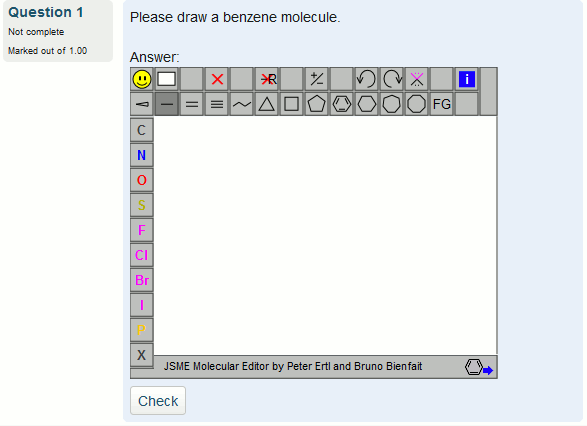
A question type where the user enters their response using the JavaScript Molecular Editor, and the response is then graded using the OU's pattern-match algorithm.
Comments
Comments are no longer open for new posts. Existing comments remain available to read.
It turns out that the zip in the Plugins directory is a bit out of date.
The git repository https://github.com/moodleou/moodle-qtype_pmatchjme is more up to date but there are two fixes that still need to be deployed to it.
I'm in the process of applying and testing the fixes. Then I will push to the repository and get the plugin zip in the plugins database updated.
I see in my access logs that a request is being made for /question/type/pmatchjme/jsme/jsme.nocache.js
This file(s) are not included in this plugin. I have the jmol/jsmol filter installed in my moodle installation. Any help would be appreciated
please read the following FAQ created recently, it hopefully explains how to clarify this plugin better.
http://docs.moodle.org/dev/Plugin_validation#Q:_I.27ve_a_plugin_to_share_that_requires_closed_.28or_non-GPL_compatible.29_source_software._Can_i_share_this_in_the_plugins_directory.3F
"
The JME editor now seems to work perfectly; however, the question engine does not recognize either of the correct answers when they are given. I assume this is a problem with the pattern match mechanism, since there is a function in the JME Editor to acquire the SMILES string and it is identical to the SMILES string entered in the question (although the question version requires escape characters, as per the manual: http://labspace.open.ac.uk/mod/oucontent/view.php?id=470268§ion=5.5.2). "
Thanks for fixing this Tim. I was using get_string to fetch the human name for the SMILES character suffixing the character with 'smiles' and then passing it to get_string. I guess one way to fix this might be to prepend big_ onto an upper case character and convert it to a lower case character appending that to smiles and looking up the translation with get_string
However, it is probably not a great idea to have two language strings that differ only be upper/lower case, so I will fix this.